Luxury Hair Website Banner Template DIY: Elevating Your Brand Without the Design Headache
In the competitive world of online beauty retail, first impressions are not just important—they are everything. When a potential customer lands on your Shopify or Wix store, you have mere seconds to convey professionalism, quality, and style. This is where a Luxury Hair Website Banner Template DIY becomes an indispensable tool for entrepreneurs who want high-end aesthetics without the high-end agency price tag. Whether you are selling ready-to-ship wigs, premium hair extensions, or lash accessories, your homepage slider sets the tone for the entire shopping experience.
However, many business owners approach website design with misconceptions that can inadvertently hurt their conversion rates. By understanding the common pitfalls associated with using premade templates and learning how to customize them effectively, you can create a digital storefront that truly reflects the luxury nature of your products.
The Misconception of "Plug-and-Play" Perfection
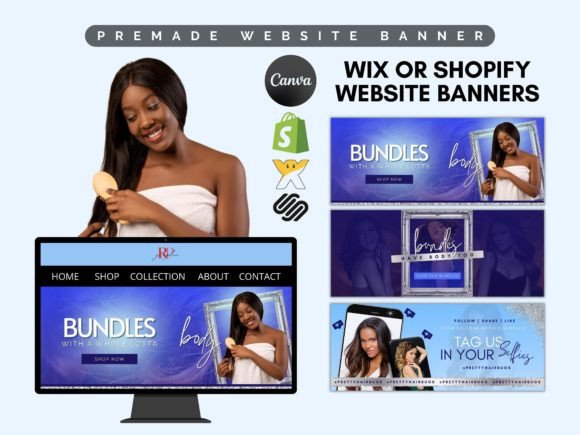
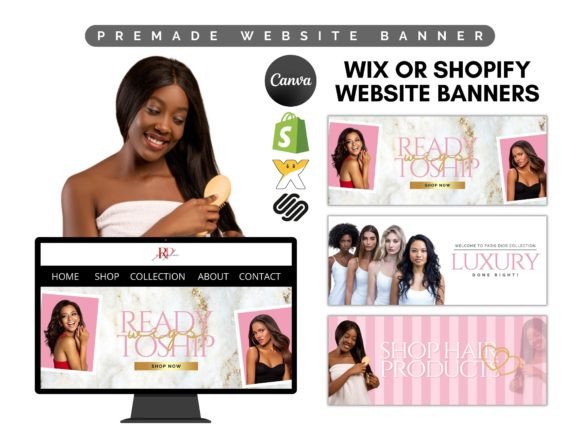
One of the most frequent mistakes beginners make when purchasing a Canva premade web slider is assuming that the template will look perfect immediately after uploading their logo. While these templates, such as the popular 1920 x 780 px designs, are beautifully crafted, they are starting points, not finish lines. A common error is leaving the default stock photography or generic placeholder text in place. This creates a disconnect between your brand promise and your visual presentation.
If you use a template designed for a general beauty business but fail to swap in high-resolution images of your specific wig textures or hair bundles, your site may look generic. Customers seeking luxury hair products are looking for authenticity. They want to see the sheen, the density, and the movement of the hair. Using low-quality images or irrelevant stock photos within a high-quality template dilutes your brand authority. The solution is simple but requires effort: always replace placeholder imagery with your own professional product photography. The drag-and-drop functionality in Canva makes this easy, but it is a step that cannot be skipped if you want to maintain credibility.
Overlooking Brand Consistency in Color and Typography
Another critical oversight occurs when entrepreneurs ignore the cohesive nature of their branding. Many Luxury Hair Website Banner Template DIY kits come with pre-selected color palettes, often featuring trendy hues like soft pinks, golds, or neutrals. While these colors are aesthetically pleasing, they may not align with your existing logo or packaging. A frequent mistake is forcing a template’s color scheme onto a brand that uses stark black-and-white minimalism or vibrant, bold tones. This visual dissonance can confuse customers and make your business appear disjointed.
To avoid this, take advantage of the fully customizable features of these templates. Since all background colors and elements are changeable, you should adjust the hex codes to match your brand guidelines exactly. Do not be afraid to remove decorative elements that clutter the design. In luxury marketing, less is often more. If the template includes excessive floral graphics or busy patterns that distract from the product, delete them. The goal is to guide the viewer’s eye to the call-to-action button and the product image, not to overwhelm them with decoration.
Neglecting Mobile Responsiveness and Readability
While the template size is fixed at 1920 x 780 px, which is standard for desktop headers, many creators forget to consider how these banners translate to mobile devices. A common misunderstanding is that what looks good on a large monitor will automatically look good on a smartphone. In reality, text that is perfectly legible on a desktop can become microscopic or get cut off on mobile screens. Furthermore, complex layouts with multiple layers of text and images can become unreadable when scaled down.
Before finalizing your banner, preview your design on various device simulations. Ensure that your primary message—such as "Ready to Ship Wigs" or "New Collection Drop"—is concise and prominent. Use strong, contrasting fonts that remain clear even at smaller sizes. If the template allows, consider creating a simplified version of the banner specifically for mobile views if your website builder supports it. This attention to detail ensures that the majority of your traffic, which likely comes from mobile users, receives a seamless and professional experience.
Ignoring the Power of Clear Call-to-Actions
A beautiful banner is useless if it does not drive action. Many small business owners focus so much on the aesthetic appeal of the Square Web Slideshow Template that they neglect the strategic placement of their call-to-action (CTA). A common error is using vague language like "Click Here" or hiding the button behind decorative elements. In the context of a hair or lash business, your CTA should be specific and enticing, such as "Shop Virgin Hair," "View Wig Collections," or "Get 10% Off Your First Order."
Ensure that your CTA button stands out visually. Use a color that contrasts with the background but still complements your overall palette. Position it where the eye naturally travels, usually towards the right side or center of the banner. Remember, the purpose of the banner is not just to look pretty; it is to convert visitors into customers. Every element, from the font size to the button placement, should serve this ultimate goal.
How to Maximize the Value of Your Template
To get the most out of your purchase, approach the editing process with a strategic mindset. Here are some practical steps to ensure your final design is both beautiful and effective:
- Audit Your Assets: Before opening Canva, gather your highest quality product images, your logo in PNG format with a transparent background, and your brand color codes. Having these ready streamlines the design process.
- Keep Text Minimal: Website banners are not brochures. Limit your text to a headline, a subheadline, and a CTA. Too much text overwhelms the user and slows down the visual impact.
- Test Contrast: Ensure there is sufficient contrast between your text and the background image. If your image is busy, use a semi-transparent overlay or a solid color block behind the text to improve readability.
- Update Regularly: One of the benefits of a DIY template is the ability to make quick changes. Rotate your banners to reflect new arrivals, seasonal sales, or holidays. A static banner can make a site feel stagnant, while fresh content signals an active, thriving business.
By avoiding these common pitfalls and leveraging the flexibility of tools like Canva, you can create a Luxury Hair Website Banner Template DIY that rivals custom-designed sites. The key is to balance aesthetic appeal with strategic functionality, ensuring that every pixel serves your brand and your customers. With the right approach, your website banner will not just be a decorative element, but a powerful driver of sales and brand loyalty.